
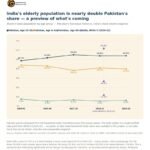
India’s elderly population is nearly double Pakistan’s share — a preview of what’s coming.
August 7, 2026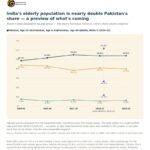
Pakistan beats India on kitchens. India beats Pakistan on schooling. What does that actually tell us?
We’ve spent this project comparing Pakistan against India and Bangladesh across dozens of indicators — education, fertility, employment, household wealth. Most of the time, the pattern is exactly what you’d expect: India ahead, Pakistan behind, gap narrowing slowly.
The kitchen data broke that pattern.
→ Separate kitchen access: Pakistan 88% urban / 64% rural vs. India 72% urban / 49% rural — Pakistan ahead by 15-16 points in both settings.
→ But years of schooling, ages 18-30: India 9.3 (women) / 10.2 (men) vs. Pakistan 6.4 / 7.9 — India ahead by roughly 2-3 years.
→ Fertility transition: India’s TFR (2.0) is already near replacement level; Pakistan’s (3.6) has barely moved in comparison.
So which country is actually “doing better”? Neither answer is complete on its own. A tempting read is that Pakistan’s growth has been more household-improvement-oriented — putting a wall between the stove and the living room — while India’s has been more human-capital-oriented — putting more years into a classroom.
If that’s roughly right, it would suggest something real about the composition of growth in each country, not just its pace.
Data: Pakistan Digital Census 2023, India NFHS-5 2019-21, plus prior education and fertility comparisons in this series.
Analysis by Gallup Pakistan Digital Analytics.