
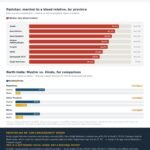
Cousin marriage in Pakistan and India: universal across every Pakistani province, concentrated in pockets in India and very marginal as compared to Pakistan. Why is this so?
July 30, 2026
India’s elderly population is nearly double Pakistan’s share — a preview of what’s coming.
We at Gallup Pakistan Digital Analytics pulled household roster microdata from five separate Pakistani surveys spanning 1990-91 to 2024-25, plus India’s most recent national survey, to see how each country’s age structure has actually shifted — not estimates, actual computed shares from every household member sampled.
The numbers:
→ India’s 60+ population share (11.7%) is 1.9 times Pakistan’s most recent figure (6.2% in 2024-25) — nearly double.
→ India’s working-age share (15-59) already stands at 61.8%, well above where Pakistan sits today (54.0%) even after three decades of steady growth from 48.7% in 1990-91.
→ India’s under-15 share (26.5%) is far below Pakistan’s (39.8%) — a full 13 points apart.
The takeaway: India isn’t just further ahead on GDP or urbanization metrics. It’s meaningfully further along the demographic transition curve — fewer children being born relative to the population, more people in their working years, and a much larger elderly population that will need pensions, healthcare, and elder care infrastructure sooner than Pakistan will. Pakistan’s demographic dividend — the economic window that opens when working-age people outnumber dependents — is still opening. India’s may be closer to its peak, with the aging challenges that come after already visible in the data.
This is built entirely from real household survey microdata — Pakistan’s DHS and Labour Force Survey waves, India’s NFHS-5 — not UN population projections. India only has one verified household-roster survey available to us, so it’s shown as a single snapshot, not a trend line, unlike Pakistan’s five points.
Data: Pakistan DHS 1990-91 & 2017-18 (NIPS), Pakistan LFS 2005-06/2018-19/2024-25 (PBS), India NFHS-5 2019-21.
Analysis by Gallup Pakistan Digital Analytics