
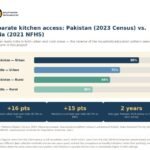
Pakistan beats India on kitchens. India beats Pakistan on schooling. What does that actually tell us?
August 10, 2026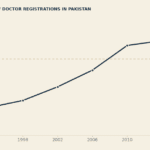
India’s elderly population is nearly double Pakistan’s share — a preview of what’s coming.
We at Gallup Pakistan Digital Analytics pulled household roster microdata from five separate Pakistani surveys spanning 1990-91 to 2024-25, plus India’s most recent national survey, to see how each country’s age structure has actually shifted — not estimates, actual computed shares from every household member sampled.
The numbers:
→ India’s 60+ population share (11.7%) is 1.9 times Pakistan’s most recent figure (6.2% in 2024-25) — nearly double.
→ India’s working-age share (15-59) already stands at 61.8%, well above where Pakistan sits today (54.0%) even after three decades of steady growth from 48.7% in 1990-91.
→ India’s under-15 share (26.5%) is far below Pakistan’s (39.8%) — a full 13 points apart.
The takeaway: India isn’t just further ahead on GDP or urbanization metrics. It’s meaningfully further along the demographic transition curve — fewer children being born relative to the population, more people in their working years, and a much larger elderly population that will need pensions, healthcare, and elder care infrastructure sooner than Pakistan will. Pakistan’s demographic dividend — the economic window that opens when working-age people outnumber dependents — is still opening. India’s may be closer to its peak, with the aging challenges that come after already visible in the data.
This is built entirely from real household survey microdata — Pakistan’s DHS and Labour Force Survey waves, India’s NFHS-5 — not UN population projections. India only has one verified household-roster survey available to us, so it’s shown as a single snapshot, not a trend line, unlike Pakistan’s five points.
Data: Pakistan DHS 1990-91 & 2017-18 (NIPS), Pakistan LFS 2005-06/2018-19/2024-25 (PBS), India NFHS-5 2019-21.
Analysis by Gallup Pakistan Digital Analytics