
Punjab’s Fertility Decline Has Already Begun — the Average Is Hiding It
July 24, 2026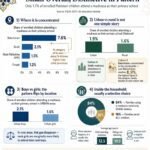
The most common marriage in Punjab is between cousins. More schooling, less consanguinity.
At Gallup Pakistan Digital Analytics, we looked at 18,599 ever-married women in the PHPS Baseline survey. 61.7% of them married a blood relative.
Nearly half of all marriages were between first cousins — split fairly evenly between the father’s side (27%) and the mother’s side (22%).
But the headline number hides the more interesting finding: cousin marriage isn’t evenly spread. It tracks three things very closely.
Education — this is the strongest pattern. Cousin marriage falls from 69% among women who never attended school to 48% among the higher-educated. And it isn’t just a rural/urban proxy: the gradient holds inside both rural and urban areas, and it shows up for the husband’s education too. More schooling, less consanguinity.
Geography. Rural women marry relatives more than urban women (66% vs 54%) — a real but smaller gap than the education one.
Age at marriage. Women who married before 16 are the most likely to have married a relative (72%), declining steadily to 51% for those who married at 26 or later. Cousin marriage and early marriage appear to be linked family strategies, not independent decisions.
One thing we’re careful about: is cousin marriage declining over time? The youngest women in the data show the highest rates, which might look like it’s rising. But that’s a statistical trap. Women already married by their early 20s are disproportionately those who married young — and marrying young is itself associated with marrying a relative. So the “ever-married” pool at young ages is skewed. This cross-sectional dataset genuinely cannot separate a real generational trend from that selection effect, and we’d be cautious of anyone claiming it can.
Why does this matter beyond curiosity? Consanguinity is one of the most studied variables in population health, because of its association with recessive-genetic conditions and infant health outcomes. When it’s this widespread — and this concentrated among the least-educated and youngest-married women — it becomes a public-health and education-policy question, not just a cultural observation.
Analysis by Gallup Pakistan Digital Analytics