
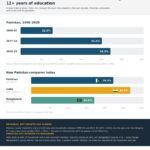
From 12% to 34%: Pakistan’s quiet education revolution — and why it’s stalling.”
July 24, 2026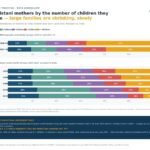
Pakistani women are marrying and starting families later. But the childbearing window stays wide open.
Gallup Pakistan Digital Analytics Pulled Pakistan’s DHS microdata from 1990-91 and 2017-18 to see how the key milestones of women’s reproductive lives have shifted over nearly three decades.
The numbers:
→ Median age at first marriage: 18.0 → 19.0 years → Median age at first birth: 20.0 → 21.0 years → Median age at last birth: 36.2 → 33.8 years
On the surface, this looks like steady, modest progress — women are marrying about a year later and starting families about a year later than they were in 1990-91.
But look at the third number. Age at last birth has barely moved — down just 2.4 years in 27 years, compared to a full year’s shift on the marriage and first-birth side. Pakistani women aren’t just marrying and starting families a bit later. Many are still having children well into their mid-to-late 30s, the same way they were nearly three decades ago.
That’s not a footnote — it’s the real story here. A childbearing window that stretches from the early 20s to the late 30s carries real implications: more total pregnancies over a woman’s reproductive life, higher-risk later pregnancies, and less recovery time between births. It also lines up exactly with what we’ve seen in Pakistan’s family-size data — large families are shrinking, but slowly, and this is a big part of why.
Data: Pakistan Demographic and Health Surveys 1990-91 and 2017-18 (NIPS).