
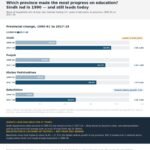
Sindh led Pakistan on education in 1990. It still does today
July 24, 2026
From 12% to 34%: Pakistan’s quiet education revolution — and why it’s stalling.”
We at Gallup Pakistan Digital Analytics have been studying development indicators in past three decades for Pakistan and also comparing it with sub continent.
Our newest learning ? The share of Pakistani households with a well-educated (12+ years of education) member has nearly tripled since 1990.
Pulled Pakistan’s DHS microdata from 1990-91 and 2017-18, plus the LFS 2024-25, to answer a simple question: how many Pakistani households have at least one member with 12+ years of education (roughly intermediate/higher-secondary or above)? Then set it against India and Bangladesh.
The trend:
→ 1990-91: 12.2% of households → 2017-18: 31.2% of households → 2024-25: 34.3% of households
That’s a near-tripling in less than three decades — genuinely significant progress. But look closer at the pace: the jump from 12% to 31% happened over 27 years (1990-91 to 2017-18), while the move from 31% to 34% happened over the following 6-7 years. The rate of educational catch-up appears to be flattening, not accelerating.
How does Pakistan compare regionally?
→ India (NFHS-5, 2019-21): 43.8% → Pakistan (LFS 2024-25): 34.3% → Bangladesh (DHS 2022): 26.6%
Pakistan sits in the middle — ahead of Bangladesh, behind India. That’s a bit of a surprising ranking given Bangladesh’s young women now out-school young men on an individual basis (from an earlier analysis) — it suggests Bangladesh’s educational gains are more evenly spread at lower levels of attainment, while Pakistan and India still have more households anchored by at least one highly-educated member.
Data: Pakistan DHS 1990-91 and 2017-18 (NIPS), Pakistan LFS 2024-25 (PBS), India NFHS-5 2019-21, Bangladesh DHS 2022.