
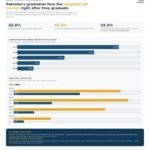
In Pakistan, a university degree can mean a longer wait for a job—not a faster one.
July 24, 2026
Pakistan’s youth are getting more educated. Just not fast enough.
Gallup Pakistan Digital Analytics pulled Pakistan’s Labour Force Survey data across three waves — 2005-06, 2018-19, 2024-25 — to see how much progress we’ve actually made on educating 18-30 year olds. Then benchmarked it against India (NFHS-5) and Bangladesh (DHS 2022).
The headline numbers:
→ Mean years of schooling for young Pakistani women has risen from 4.2 to 6.4 over two decades. Young men: 6.2 to 7.9. The gender gap has narrowed — 2.0 years to 1.5 — but it hasn’t closed.
→ Regionally, we’re behind both neighbors. India averages 9.3 (women) / 10.2 (men) years. Bangladesh averages 8.5 / 8.1 — not a typo. Young Bangladeshi women now average more schooling than young men, the only one of the three countries where that’s true.
→ But the real story isn’t the average — it’s where the gap sits. 34% of young Pakistani women have no formal education at all, versus 17% of men. That’s the crisis. Once women clear that bar and reach university, they hold their own: 7.1% of women vs 7.5% of men have a bachelor’s or higher, and women are slightly ahead at postgraduate level (3.0% vs 2.4%).
→ Punjab shows what’s possible domestically — matric-plus attainment is basically at gender parity there (49% women, 48% men), and Punjabi women actually lead men in tertiary education. Balochistan is a different country entirely: 17% of young women vs 43% of young men reach matric.
The policy implication is pretty clear: this isn’t primarily a “get more women into universities” problem. It’s a “keep girls in school past primary” problem. Bangladesh’s stipend-and-labor-demand model offers a tested playbook — we don’t have to guess at what works.
Data: Pakistan LFS 2005-06 / 2018-19 / 2024-25 (PBS), India NFHS-5 (2019-21), Bangladesh DHS 2022.