
Where Pakistan’s medically-trained women leave the workforce — and where they come back.
July 28, 2026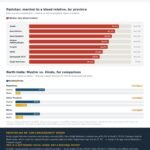
Border to border: how do Muslim households compare across the Pakistan-India line?
Gallup Pakistan Digital Analytics team compared household assets using the actual geographic pairs that face each other across the border — not national averages, but region to region: Punjab-Punjab, Sindh-Rajasthan, and Azad Kashmir-Jammu & Kashmir.
Visit dashboard here : https://lnkd.in/da8qXE8j
India figures are restricted to Muslim-headed households specifically, for a genuine like-for-like comparison.
Punjab ↔ Punjab: Indian Punjab’s Muslim households actually lead on electricity (99.8% vs 95.1%) and refrigerator ownership (73.0% vs 60.5%) — though this comes from a small sample (n=214) and should be read cautiously.
Sindh ↔ Rajasthan: Pakistani Sindh trails on every basic-infrastructure metric — electricity (88.0% vs 98.5%) and mobile access (90.1% vs 97.7%) both lag Rajasthan’s Muslim households. Likely Sindh’s sharp urban-rural divide (Karachi vs. the rest) pulling its average down.
Azad Kashmir ↔ Jammu & Kashmir: Nearly identical on electricity and mobile phones — but Indian J&K’s Muslim households report 21.7% car ownership, roughly double Pakistani AJK’s 11.0%. That’s the single widest gap found in any pair on any metric.
The bigger picture: basic infrastructure (electricity, mobile connectivity) has essentially converged across the border for both Pakistani households and Indian Muslim households alike — every pair sits within a few points of each other. But genuine wealth indicators (refrigerators, cars) show real, sometimes surprising divergence that doesn’t follow a simple “one side ahead” story. It varies pair by pair, asset by asset.
Data: Pakistan DHS 2017-18 (NIPS), India NFHS-5 2019-21 (Muslim-headed households only).
Analysis by Gallup Pakistan Digital Analytics.