
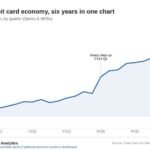
Six years ago, roughly 25 million debit cards were in circulation across Pakistan’s banks. Today (Q3 FY26), that number stands at 57.2 million — more than double.
July 27, 2026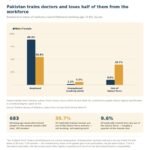
Our Universities Are Producing Employees for the State, Not Entrepreneurs for the Economy
This is a shocking number.
Access the dashboard here to understand Punjab’s economy and demography and similar topics as discussed here :
https://lnkd.in/dpfFD3Kc
Among people with higher education, 20.4% report government service as their main source of household income.
The proportion falls sharply as education declines:
Secondary: 8.2%
Middle: 3.3%
Primary: 2.0%
No education: 1.5%
In other words, the more educated a person becomes, the more likely their household is to depend on the state for employment.
This is not merely a labour-market pattern. It tells us something uncomfortable about the purpose and structure of our education system.
For millions of families, education is not imagined as a pathway to entrepreneurship, innovation or business creation. It is seen as a route to a secure government job—with a fixed salary, pension, status and protection from economic uncertainty.
The result is a dangerous mismatch: universities continue producing graduates whose aspirations are concentrated in a very small formal and public-sector job market. When those jobs do not expand at the same pace, graduate unemployment and frustration become inevitable.
Government employment is necessary. But an economy cannot prosper when its most educated citizens are trained primarily to seek security from the state rather than create value outside it.
At Gallup Pakistan Digital Analytics, we want to enrich Pakistan’s public conversation with data. Numbers like these force us to ask a deeper question:
Is our education system expanding people’s economic possibilities—or simply increasing the queue outside government offices?
Access the dashboard here to understand Punjab’s economy and demography and similar topics as discussed here :
https://lnkd.in/dpfFD3Kc