
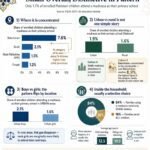
Only 1.7% of enrolled Pakistani children attend a madrassa as their primary school — but the pattern of who goes, and how families decide, is more interesting than the small number suggests.
July 24, 2026
Do families stop having children once they have a son? We tested it.
Using birth-history data from the Punjab Health & Population Survey (PHPS Baseline, Bureau of Statistics Punjab), we ran two independent tests of the classic “son-preference stopping rule” hypothesis — the idea that families keep having children until they achieve a desired number of sons, then stop.
Both point the same direction.
→ Test 1 — what actually happened: among the same women, births that were followed by another pregnancy were 50.4% male. Births that turned out to be her last were 54.0% male. The only difference between these two groups is birth-order position — and sons are disproportionately the ones a family stops on.
→ Test 2 — what women say they want: hold total family size constant and vary only the sex mix. Among women with exactly 3 living children, 72% of mothers of 3 daughters still want more children. Among mothers of 2 sons and 1 daughter — same total, three children — only 18% do. A 4x gap, driven entirely by whether a son is already in the family.
The pattern isn’t purely “sons good, daughters bad” — families with all sons and no daughter also want slightly more than perfectly balanced families, suggesting some real desire for a daughter too. But the asymmetry is stark: not having a son drives continued childbearing far more than not having a daughter does.
Two different kinds of evidence — revealed behavior and stated preference — independently confirming the same mechanism. That’s about as strong as this kind of finding gets from survey data.
Full breakdown in the graphic.
hashtag#DataAnalytics hashtag#Punjab hashtag#GenderData hashtag#Demography hashtag#Pakistan hashtag#GallupPakistan hashtag#SonPreference
—
Source: PHPS Baseline (Bureau of Statistics Punjab)
Analysis & visualization: Gallup Pakistan Digital Analytics