
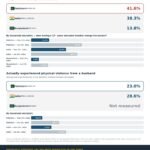
Pakistan has the highest rate of justifying wife-beating among its South Asian neighbors. Education is the sharpest dividing line by far.
July 24, 2026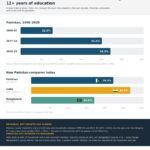
Sindh led Pakistan on education in 1990. It still does today.
Gallup Pakistan Digital Analytics team Pulled Pakistan’s DHS microdata from 1990-91 and 2017-18 to see which provinces have actually closed the education gap over nearly three decades — and which haven’t moved as much as you’d expect.
The measure: share of households with at least one member holding 12+ years of education (roughly intermediate/higher-secondary or above).
The results:
→ Sindh: 14.4% → 33.5% (+19.1 points) — led in 1990-91, still leads in 2017-18
→ Punjab: 12.0% → 31.7% (+19.7 points)
→ KP: 10.5% → 28.4% (+17.9 points)
→ Balochistan: 6.4% → 21.1% (+14.7 points) — smallest absolute gain, but more than tripled (3.3x) off the lowest base
Two things stand out:
1. Sindh’s lead has been remarkably stable. Despite enormous urban-rural divides within the province — Karachi’s education infrastructure versus rural Sindh’s — Sindh has topped every other province at both points in time. That’s very likely Karachi doing the heavy lifting on the provincial average; a district-level breakdown would probably show a much starker internal divide than the four-province numbers suggest.
2. Balochistan is closing the gap fastest in relative terms — but the absolute distance is still enormous. Its 2017-18 level (21.1%) is roughly where Sindh and Punjab already stood back in 1990-91. Balochistan isn’t just behind — it’s a full generation behind on this measure, even after genuine, accelerating progress.
Why does this matter beyond the numbers? Household-level education access shapes everything downstream: who gets employed in salaried jobs versus informal work, health-seeking behavior, girls’ school retention, civic participation, and ultimately what public services a province can staff and deliver locally. A province stuck a generation behind on education isn’t just behind on one metric — it’s behind on the entire chain of development outcomes that education unlocks. Provincial education policy in Pakistan can’t be one-size-fits-all; Balochistan and KP need fundamentally different levels of investment and intervention than Punjab and Sindh do at this point.
Data: Pakistan Demographic and Health Surveys 1990-91 and 2017-18 (NIPS).