
Age and Gender: The Electorate of Pakistan
August 8, 2025
Beneath the Stamp: Passports, Policies, and People
August 8, 2025By Muhammad Ali Ozain
Intern – GDAP Summer Program 2025
In a country where air travel bridges vast geographies and connects economic hubs, aviation is
more than a convenience – it’s an infrastructure lifeline. Between domestic and international operations, Pakistan’s airports
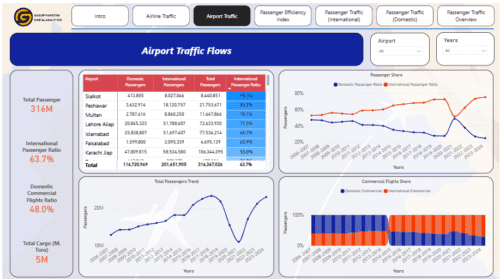
handled over 316 million passengers, with an embark-to-disembark ratio of 1.00, indicating a well-balanced flow. Karachi’s Jinnah
International Airport leads the charts with 106 million passengers, nearly evenly split between
domestic and international travellers. Meanwhile, Sialkot’s airport, though smaller, stands out
with a 95% international passenger ratio, highlighting its role in labour migration and
export-linked travel.
On the airline front, Pakistan International Airlines (PIA) carried nearly 70 million passengers,
commanding the largest share, followed by Air Blue and Shaheen Air. Yet, the market has
diversified sharply since 2018, with Fly Jinnah, Air Sial, and Serene Air gaining ground, as seen
in both passenger share and market efficiency.
Efficiency metrics tell another story. The Passenger Efficiency Index (PEI) – which tracks how
well airlines fill their flights – shows Air Blue and Air Sial outperforming legacy carriers,
suggesting leaner operations and improved planning.
Domestic travel patterns also indicate fluctuations over the years, with COVID-19 causing a
sharp dip in 2020-21, but traffic has steadily recovered since. Islamabad and Lahore airports lead
in domestic throughput, with emerging activity in underserved regions like Bahawalpur and
Gilgit.
For More Information:
https://galluppakistandigitalanalytics.com/aviation-statistics-dashboard/